Clean Agent Fire Suppression Systems
A fire in a server room, data center, control room, or records archive cannot be fought with water. Water destroys the same equipment the system is meant to protect. Dry chemical leaves a residue that contaminates electronics and requires extensive cleanup before operations can resume. Clean agent fire suppression systems solve both problems; they suppress fire using a gaseous agent that evaporates completely, leaves no residue, and is electrically non-conductive.
Valley Fire Control designs and installs FK-5-1-12 and inert gas clean agent systems for facilities across Oregon and Idaho. We also inspect, test, maintain, and service existing systems of all agent types, including systems installed by other contractors. Whether your facility is planning a new installation, maintaining an existing system, or facing an agent replacement decision, our team can assess the space and give you a clear path forward.
Clean agent systems fall within the broader category of special hazard fire protection environments where standard suppression methods are not appropriate for the risk.
What Makes a System "Clean Agent"
The term refers to the absence of residue after discharge. A clean agent suppresses fire as a gas or vapor and then evaporates, leaving no water, powder, or chemical film on servers, storage media, instruments, documents, or artwork. The protected equipment can be assessed and returned to service without a major cleanup process.
Chemical clean agents primarily suppress fire by absorbing heat rapidly and interrupting the chemical combustion process. This differs from CO2 or inert gas systems, which suppress fires by reducing oxygen concentration. Because chemical clean agents work at lower concentrations, properly designed systems can protect spaces where personnel may be present, provided the correct notification, alarm, and evacuation controls are in place.
All clean agent systems installed and serviced by Valley Fire Control are designed and maintained in accordance with NFPA 2001, the Standard on Clean Agent Fire Extinguishing Systems, and applicable local authority requirements.
The Agents Valley Fire Installs Today
FK-5-1-12
FK-5-1-12 is a fluoroketone clean agent and Valley Fire Control's standard recommendation for new chemical clean agent installations. 3 M previously marketed it under the Novec 1230 trade name, and discontinued production at the end of 2025. FK-5-1-12 is available today from multiple manufacturers and is not subject to the HFC phasedown restrictions that affect FM-200 and similar agents.
FK-5-1-12 offers the properties facilities expect from a modern clean agent:
- Residue-free discharge - no water, powder, or film on protected equipment or records
- Electrically non-conductive - safe for use around energized servers, switchgear, and control panels
- Fast suppression - designed to reach required concentration within seconds of activation
- Suitable for occupied spaces at established design concentrations, with required alarm and evacuation controls in place
- Zero ozone depletion potential and a global warming potential of 1 - the same as CO2
- Not subject to the AIM Act HFC phasedown, giving it a long, predictable service and recharge outlook
That last point matters for long-range planning. Facilities specifying a new system today generally want an agent with stable availability and predictable recharge costs over a 20-plus-year service horizon. FK-5-1-12 currently offers that.
Inert Gas Systems
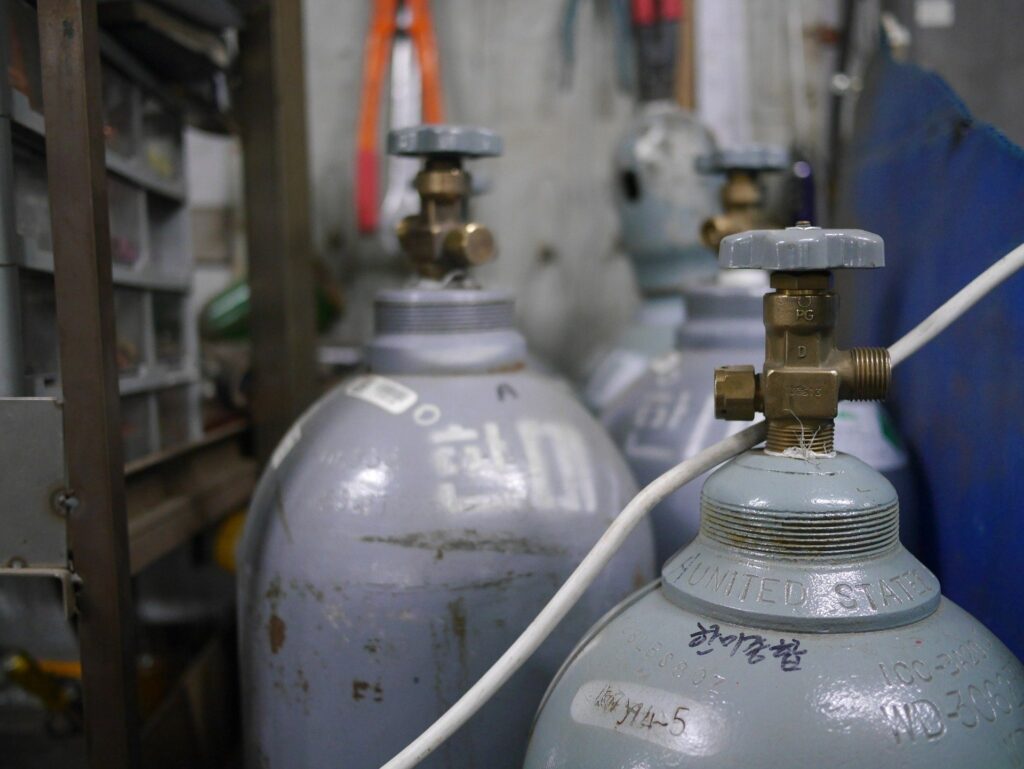
Our inert gas suppression systems use naturally occurring gases - nitrogen, argon, or blends such as IG-55 and IG-541- to suppress fire by reducing the oxygen concentration within a protected enclosure to a level that cannot sustain combustion, while remaining within life-safety limits for occupied spaces when correctly designed.
Inert gases carry zero ozone depletion potential, zero global warming potential, and no supply-chain exposure to regulatory phase-downs. They are a strong engineering choice for larger enclosures, facilities with long capital planning horizons, and owners who want to eliminate fluorinated agents entirely.
The tradeoff is physical scale. Inert gas systems require substantially more cylinder storage, larger piping, and enclosure pressure relief venting that must be engineered into the space. For some rooms this is straightforward. For others, space constraints make FK-5-1-12 the more practical option. Valley Fire Control will assess the room before recommending an agent.
Do I Need to Replace My Existing System?
In most cases, no, not immediately. The AIM Act phases down HFC production; it does not declare existing installed systems illegal or require removal. A properly maintained FM-200 or similar system that holds its agent and meets local authority requirements can generally remain in service.
The decision points typically arise at one of these moments:
- After a discharge, when the system needs recharging and agent availability and cost become real factors
- When inspection reveals a leak, a damaged cylinder, or a control panel that cannot be economically repaired
- When a room is remodeled, equipment changes, or enclosure integrity is compromised
- During capital planning, when an owner wants a system with a predictable long-term service outlook
Valley Fire Control can inspect your existing system, document its condition, and give you a clear picture of your options, including the cost and timeline of continuing to maintain it versus converting to FK-5-1-12 or inert gas.
System Design and Installation
A clean agent system begins with a detailed site and hazard review. Before any hardware is specified, Valley Fire Control evaluates:
- Room dimensions, ceiling height, and volume calculations
- Raised floors and ceiling voids that must be included in the protected volume
- Ventilation, air movement, and HVAC integration
- Door, wall, and penetration conditions affecting enclosure integrity
- Equipment arrangement, value, and classification
- Occupancy type and safety limits for the selected agent
- Cylinder storage space and piping routing
- Detection device type and placement
- Release controls, abort controls, and notification
Enclosure integrity is one of the most critical and most frequently overlooked factors. The system must deliver the required agent concentration and hold it long enough to control the fire. Rooms remodeled, re-cabled, or modified after the original installation may no longer meet the design parameters. Our fire system integrity testing includes door fan testing to verify that a room can hold the required concentration before a discharge event reveals the problem.
An automatic clean agent system includes smoke or heat detection, a release control panel, audible and visual notification, manual release controls, abort controls, equipment shutdown connections, agent cylinders, discharge piping, and nozzles. Our Edwards fire alarm systems integrate directly with suppression release controls to enable a coordinated detection-to-discharge response.
Why Valley Fire Control
Valley Fire Control has been servicing special hazard fire protection systems in Oregon since 1952. General Manager Kyle Cox holds NICET Level III certification in special hazards, with hands-on expertise across clean agents including Halon, FM-200, and the current-generation FK-5-1-12 systems, as well as inert gas in both IG-55 and IG-541 configurations. That depth of experience means we can assess legacy systems accurately and make honest recommendations, including when an existing system is fine to maintain and when conversion makes economic sense.
- NICET Level III in special hazards through technical leadership
- Over 70 years of fire protection experience in Oregon and the Pacific Northwest
- NAFED, ORFED, FSSA, and NFPA membership, reflecting current standards involvement
- Services all agent types, FK-5-1-12, inert gas, FM-200, Halon, and others
- 24-hour emergency availability from Albany, Newport, and Nampa offices
- Full inspection documentation after every service visit
Our Oregon and Idaho locations cover the Willamette Valley, Oregon Coast, and Treasure Valley, keeping response times manageable for facilities throughout our service territory.
Get a System Assessment
Clean agent selection is an engineering decision, not a catalog choice. The right answer depends on the room, the hazard, the equipment, the occupancy, the available cylinder space, and how long you intend to own and operate the facility. Valley Fire Control will assess your space, evaluate any system already in place, and give you a straight recommendation.
Contact our team to get an estimate or schedule a consultation for your Oregon or Idaho facility.